Matrix Multiply (GEMM)
Tiled matrix multiplication using meTile’s dot and tile_load operations.
Basic GEMM
import metile

@metile.kernel
def matmul(A, B, C, M, N, K,
           BLOCK_M: metile.constexpr, BLOCK_N: metile.constexpr,
           BLOCK_K: metile.constexpr):
    pid_m = metile.program_id(0)
    pid_n = metile.program_id(1)

    acc = metile.zeros((BLOCK_M, BLOCK_N), dtype="f32")
    for k in metile.tile_range(0, K, BLOCK_K):
        a = metile.tile_load(A, pid_m * BLOCK_M, k, K, (BLOCK_M, BLOCK_K))
        b = metile.tile_load(B, k, pid_n * BLOCK_N, N, (BLOCK_K, BLOCK_N))
        acc = metile.dot(a, b, acc)

    metile.tile_store(C, pid_m * BLOCK_M, pid_n * BLOCK_N, N, acc, (BLOCK_M, BLOCK_N))
Launching
The grid is 2D, one program instance per output tile:
import numpy as np

M, N, K = 1024, 1024, 1024
A = metile.Buffer(data=np.random.randn(M, K).astype(np.float32))
B = metile.Buffer(data=np.random.randn(K, N).astype(np.float32))
C = metile.Buffer.zeros((M * N,))

grid = (metile.cdiv(M, 128), metile.cdiv(N, 128))
matmul[grid](A, B, C, M, N, K, BLOCK_M=128, BLOCK_N=128, BLOCK_K=64)
How It Works
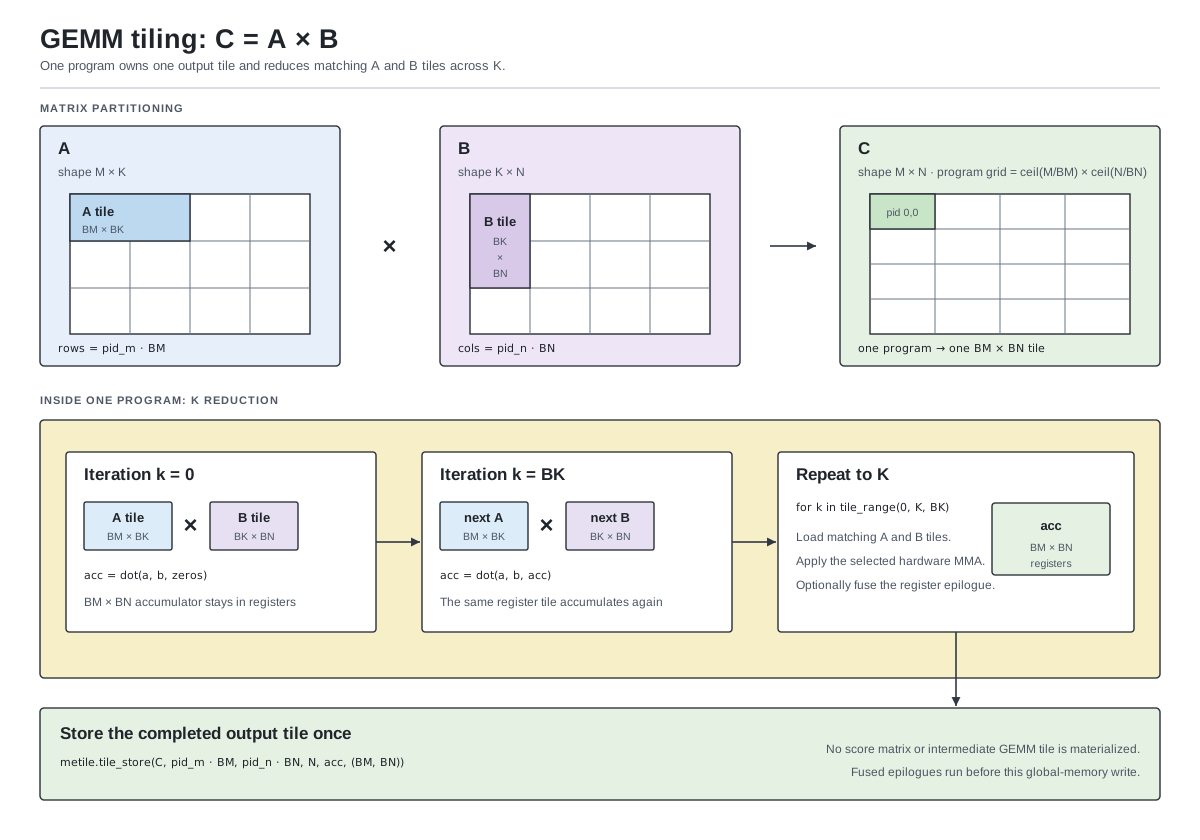
Each program instance owns a
BLOCK_M x BLOCK_Ntile of the output matrix C.It initializes a register-resident accumulator with
metile.zeros.The K-loop iterates in steps of
BLOCK_K, loading a tile of A and B each step.metile.dot(a, b, acc)computesacc += a @ busing hardware matrix multiply.After the loop, the accumulated result is written to C.
The compiler maps dot to the appropriate hardware:
M1/M2/M3:
simdgroup_matrix<float, 8, 8>with cooperative loads through threadgroup memoryMetal 4-capable GPU/toolchain:
matmul2dtensor_ops with register-residentcooperative_tensor
Fused GEMM + ReLU
Element-wise operations after the GEMM loop are fused into the kernel’s epilogue. They run on register-resident data with zero extra memory traffic:
@metile.kernel
def matmul_relu(A, B, C, M, N, K,
                BLOCK_M: metile.constexpr, BLOCK_N: metile.constexpr,
                BLOCK_K: metile.constexpr):
    pid_m = metile.program_id(0)
    pid_n = metile.program_id(1)
    acc = metile.zeros((BLOCK_M, BLOCK_N), dtype="f32")
    for k in metile.tile_range(0, K, BLOCK_K):
        a = metile.tile_load(A, pid_m * BLOCK_M, k, K, (BLOCK_M, BLOCK_K))
        b = metile.tile_load(B, k, pid_n * BLOCK_N, N, (BLOCK_K, BLOCK_N))
        acc = metile.dot(a, b, acc)
    acc = metile.where(acc > 0, acc, 0)   # fused ReLU, no global memory round-trip
    metile.tile_store(C, pid_m * BLOCK_M, pid_n * BLOCK_N, N, acc, (BLOCK_M, BLOCK_N))
Tile Swizzle for Cache Locality
For large matrices, the order in which tiles are processed affects cache hit rates.
The compiler can specialize linear, grouped-2/4/8, diagonal, Morton (Z-order), and
4x4 Hilbert traversals. Use tile_swizzle to force a schedule:
@metile.kernel
def matmul_swizzled(A, B, C, M, N, K,
                    BLOCK_M: metile.constexpr, BLOCK_N: metile.constexpr,
                    BLOCK_K: metile.constexpr):
    pid_m, pid_n = metile.tile_swizzle(
        metile.program_id(0), metile.program_id(1),
        pattern="morton", block_size=2,
    )
    acc = metile.zeros((BLOCK_M, BLOCK_N), dtype="f32")
    for k in metile.tile_range(0, K, BLOCK_K):
        a = metile.tile_load(A, pid_m * BLOCK_M, k, K, (BLOCK_M, BLOCK_K))
        b = metile.tile_load(B, k, pid_n * BLOCK_N, N, (BLOCK_K, BLOCK_N))
        acc = metile.dot(a, b, acc)
    metile.tile_store(C, pid_m * BLOCK_M, pid_n * BLOCK_N, N, acc, (BLOCK_M, BLOCK_N))
pattern="auto" runs the schedule-algebra pass. For a statically known launch
grid it emits only the selected branch-free coordinate decoder. Explicit Hilbert
and Morton schedules safely fall back on grids that cannot be tiled bijectively.
Autotuning
Different matrix sizes benefit from different block sizes. Use the autotuner to search:
autotuned_matmul = metile.autotune(
    configs=[
        metile.Config(BLOCK_M=64,  BLOCK_N=64,  BLOCK_K=32, WM=2, WN=2),
        metile.Config(BLOCK_M=128, BLOCK_N=128, BLOCK_K=64, WM=4, WN=4),
    ],
    key=["M", "N", "K"],
)(matmul)

grid = lambda cfg, M=M, N=N: (metile.cdiv(M, cfg["BLOCK_M"]), metile.cdiv(N, cfg["BLOCK_N"]))
autotuned_matmul[grid](A, B, C, M, N, K)
See Autotuning for the full autotuning guide.
Concepts Introduced
metile.zeros: register-resident accumulator initializationmetile.dot: tile-level matrix multiply-accumulatemetile.tile_load/metile.tile_store: 2D strided memory access2D grids:
kernel[(grid_m, grid_n)]Fused epilogues: element-wise ops after GEMM are free
Tile swizzle: cache-friendly scheduling patterns