Tile Operations & Hardware Mapping
meTile’s tile operations are the bridge between your Python code and Apple GPU hardware.
This page explains how dot, tile_load, and tile_store map to the actual
hardware instructions.
The Two Backends
meTile automatically selects the best backend for your hardware when compiling GEMM kernels:
- Simdgroup Matrix
Uses
simdgroup_matrix<float, 8, 8>, Apple’s 8x8 matrix multiply-accumulate primitive. Each simdgroup (32 threads) collaboratively computes an 8x8 tile. The compiler tiles the output across multiple simdgroups and uses threadgroup (shared) memory to stage data.- Metal 4 Tensor Ops
Uses
matmul2dwithcooperative_tensor, Metal 4’s hardware matrix multiply descriptors. On supported GPU/toolchain combinations, each simdgroup can load data from device memory into register-resident cooperative tensors and run the MMA. The tuned M5 path also supports explicit NAX fragment load/MMA/store operations.
You write the same kernel code for both. The lower() function in the compiler inspects
your hardware and chooses the right path.
How Tiling Works
A GEMM kernel tiles the computation into blocks. Each program instance computes one output tile, iterating over K to accumulate partial products:
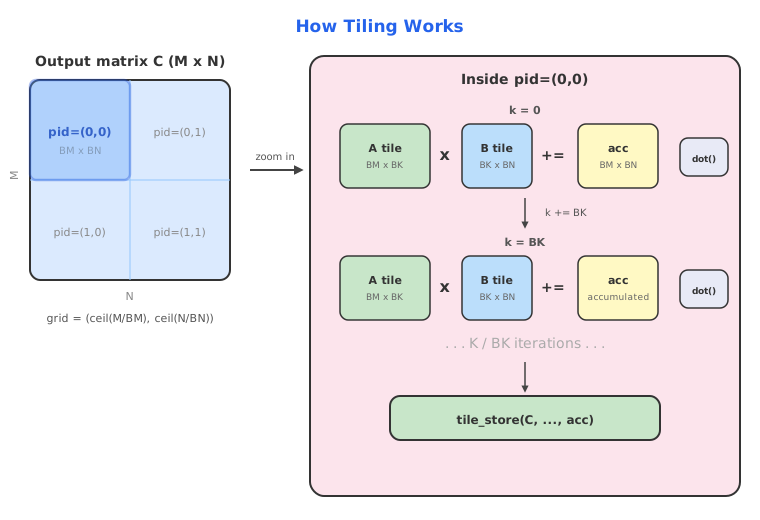
acc = metile.zeros((BLOCK_M, BLOCK_N))
for k in metile.tile_range(0, K, BLOCK_K):
    a = metile.tile_load(A, row, k, K, (BLOCK_M, BLOCK_K))
    b = metile.tile_load(B, k, col, N, (BLOCK_K, BLOCK_N))
    acc = metile.dot(a, b, acc)    # acc += a @ b
Compiler Constexprs
The tile sizes are compile-time constants that control how the hardware is used:
Constexpr |
Meaning |
Typical Values |
|---|---|---|
|
Output tile rows |
64, 128 |
|
Output tile columns |
64, 128 |
|
K-loop step size |
32, 64, 128 |
|
Simdgroup grid rows (tensor_ops only) |
2, 4 |
|
Simdgroup grid cols (tensor_ops only) |
2, 4 |
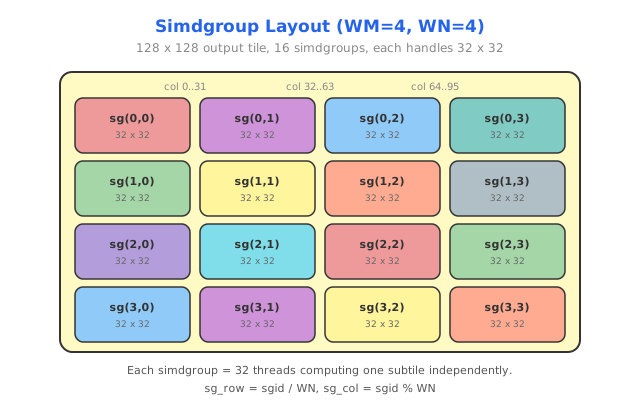
WM and WN control how many simdgroups tile the output block. With WM=4, WN=4,
16 simdgroups each handle a (BLOCK_M/WM) x (BLOCK_N/WN) = 32x32 subtile:
Fused Epilogues
The compiler detects element-wise operations applied to the accumulator after the GEMM loop and fuses them into the kernel. No extra memory traffic:
acc = metile.dot(a, b, acc)

# These are fused into the GEMM, no global memory round-trip
acc = metile.where(acc > 0, acc, 0)      # ReLU
acc = acc * scale                          # scale
acc = metile.exp(acc)                      # unary
Supported epilogues: where (ReLU), exp, log, sqrt, abs, tanh,
scalar multiply, scalar add.
Tile Scheduling
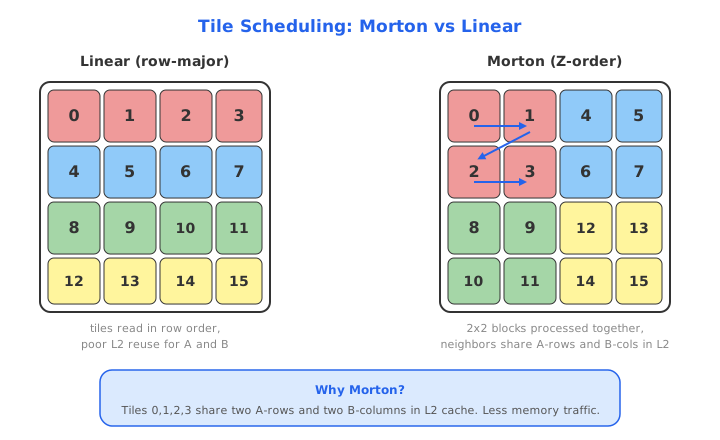
For 2D grids, the order in which tiles are assigned to threadgroups affects L2 cache locality. meTile supports several scheduling patterns:
- Diagonal:
Column assignment is rotated by the row index. Distributes memory traffic.
- Linear:
Simple row-major assignment. No locality optimization.
- Grouped-2/4/8:
Visits a short group of neighboring M tiles before advancing N, increasing reuse of the same B region for shapes where that order wins.
- Morton:
Visits complete 2x2 panels in Z order.
- Hilbert:
Visits complete 4x4 panels along a Hilbert curve with unit-distance steps inside each panel.
The compiler represents each schedule as a finite permutation, removes candidates that are equivalent under shape-preserving symmetries, and searches the remaining representatives. You can override it:
pid_m, pid_n = metile.tile_swizzle(
    metile.program_id(0), metile.program_id(1),
    pattern="morton", block_size=2,
)
Composable NAX Fragment Lowering
The M5 register path does not emit a whole GEMM template. Initial lowering produces
compact NAX setup, reduction, epilogue, and store operations. The
decompose_nax_fragments Metal IR pass expands them into independently transformable
operations for tile/lane layout, accumulator initialization, vector fragment loads,
cooperative-tensor packing, native matmul2d MMA, per-fragment element-wise apply,
and fragment stores. GELU, SiLU, ReLU, and other detected chains therefore remain
register-resident on the direct NAX path rather than forcing a slower lowering family.
The autotuner can therefore vary reduction epochs and preload two adjacent K fragments before issuing their MMAs without changing the frontend kernel. Epoch pointers reduce address arithmetic, static aligned dimensions remove scalar buffer bindings, and the runtime measures one- and two-fragment representations per problem shape. A separate candidate skips only the redundant first epoch barrier while preserving the fences that bound compiler scheduling and register live ranges between epochs. Another candidate moves those fences to the tails of non-final epochs, which gives the Metal compiler a different but equivalent live-range boundary for sustained reductions. The preload form is retained only for dense GEMM; measurements show that applying it to fused MXFP decode increases register pressure. Block-scaled lowering instead keeps decoded weights single-step-live while optionally pairing two K steps and reusing their common E8M0 scale fragments. This reduces scale traffic and loop overhead without retaining both decoded weight fragments across an MMA.
Block-Scaled Register Fragments
MXFP4 and MXFP8 matmul lowering is composed from Metal IR operations for schedule selection, vectorized E2M1/E4M3 plus E8M0 decoding, fragment MMA, and stores. The autotuner compares conventional threadgroup staging with a direct M5 path that keeps decoded fragments and accumulators in registers. No dense weight tensor is materialized in global memory. Float and bfloat right-fragment representations are both measured because bfloat lowers register footprint on sustained M5 workloads while float can remain faster for launch-limited shapes. One- and two-step reduction forms are measured independently because paired scale reuse wins at small and medium K but can reduce occupancy on larger problems.
Affine Uint4 Register Fragments
Affine weight-only lowering uses the same fragment IR rather than a dedicated whole-kernel
template. MNaxLoadAffineParameters reuses one FP16 scale/bias vector across a 64-value
K group, MNaxLoadAffineFragment decodes K-major uint4 nibbles directly into half
cooperative-tensor inputs, and masked left loads/stores specialize the one-row decode case.
MNaxBinaryFragment composes gate and up accumulators with SwiGLU while they remain in
registers. The MLX backend can therefore compare scalar output-major execution, native MLX,
and this NAX representation without changing fusion legality or the frontend model graph.
One-row gated projections can instead select a sequential fragment lifetime. The lowering
uses MNaxSpillFragment and MNaxReloadFragment around
MNaxAccumulatorReset rather than owning a second kernel template. Per-lane fragments are
transposed in threadgroup scratch as element * 32 + lane so every SIMDgroup memory
instruction reaches all 32 banks without conflict. Only the two live output fragments are
computed; the masked rows that cannot contribute to a one-token result never receive an MMA.